Every construction site has to stop mud, gravel and sediment leaving on vehicle tyres. There are several ways to do it, from a traditional rock exit to rumble grids, wheel washes and reusable trackout mats. Each has its place, and the right choice depends on how long the job runs, how busy the exit is, the ground conditions and how much time the crew can spend maintaining it. This guide compares the main trackout control options used on Australian sites.
The short answer: for most sites, a Rubberform® trackout control mat is the best all-round option. It cleans tyres effectively, goes down in minutes with no digging, needs very little maintenance, works on almost any surface, moves from job to job and is made from 100% recycled rubber. Read on for how it compares with the alternatives.
What is trackout and why control it?
Trackout is the mud, dirt and debris carried off a site on tyres and dropped onto public roads. It makes roads slippery, washes into stormwater drains and is one of the first things councils and road authorities notice. Most sites are expected to have a stabilised exit or trackout control system in place, and a well set-up exit also cuts down on street sweeping and complaints from neighbours.
All trackout systems work in a similar way. They make the tyre tread flex or vibrate as it rolls, which breaks packed material loose so it drops on site. The more full wheel rotations a tyre makes across the system, the cleaner it leaves, so exit length matters as much as the product you choose.
The main trackout control options
Rock or ballast exits
A bed of coarse crushed rock at the site exit is the traditional approach. It is simple and familiar, but it needs excavation and imported material to build, and it clogs with sediment over time. Once it fills up it stops cleaning tyres and has to be dug out, topped up or replaced, and at the end of the job the contaminated rock usually has to be removed and disposed of.
Rumble grids
Rumble grids use raised ribs to shake debris off tyres as vehicles drive across. They are tough and effective on busy exits, and they work well on their own or combined with mats to add cleaning length. Some systems are set into an excavated pit, while modular surface-laid grids can be moved as the site changes. Grids need regular clearing underneath as material builds up.
Wheel wash systems
Wheel washes spray tyres and undercarriages with water and give the cleanest result, which suits long-term projects, quarries and sites next to sensitive areas. They are also the most expensive option, need water supply, power and a way to manage the dirty water, and take up more space at the gate.
Paved exits
Some long-term sites pave a length of concrete at the exit, often around 30 metres, so debris falls onto the slab rather than the road. It is low maintenance once built, but it takes time to pour and cure, has a high upfront cost and is permanent. On its own, paving does little to shake or wash stubborn sediment out of tyre treads, so it is usually combined with another system.
Reusable trackout mats
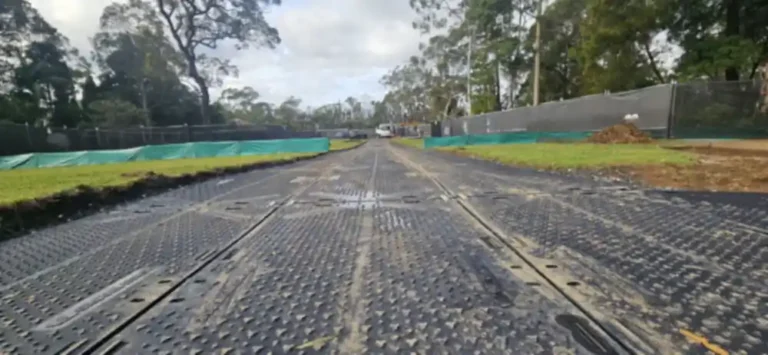
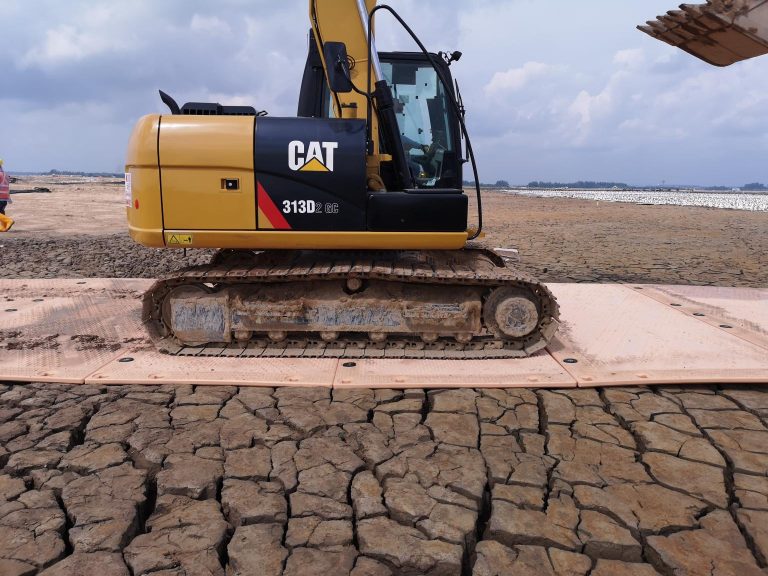
Trackout mats are laid straight onto the exit, with no digging, and lifted and moved when the job changes. They come in two main types: flexible recycled rubber mats, and rigid moulded plastic (HDPE) mats. Both are a big step up from rock in terms of reuse and waste. The differences between them are mostly about fit to the ground, cleaning and repairs, covered below.
Trackout control options compared
| Option | Set-up | Ongoing maintenance | Reusable | Best for |
|---|---|---|---|---|
| Rock or ballast exit | Excavate and import rock | Top up or replace when clogged, dispose of at the end | No | Low budget, simple exits |
| Rumble grids | Surface-laid or set into a pit, depending on the system | Clear built-up material underneath | Yes | Busy exits, extra cleaning length |
| Wheel wash | Water, power and space at the gate | Manage water and sludge | Yes | Long projects, sensitive sites |
| Paved exit | Pour and cure concrete, around 30 m long | Low, sweep the slab | No | Long-term sites, combined with another system |
| Rubberform® rubber trackout mats | Lay on the surface in minutes, no digging or anchors | Very low: lift and shake out, replace individual blocks if damaged | Yes, folds for transport | Most sites, short or long term, any surface |
| Plastic (HDPE) trackout mats | Lay on the surface, no anchors | Clear packed debris from the surface, flip or lift with machinery | Yes | Flat, firm exits |
Rubber and plastic trackout mats: what’s the difference?
Fit to the ground
Rubber mats are flexible and follow dips, ruts and slopes, so they stay in contact with the ground across the whole exit. Rigid plastic mats are flat panels, which suits firm, level surfaces, and their load ratings are generally quoted for flat, solid ground.
Cleaning
Any trackout mat needs clearing once it fills with mud, because a full mat stops flexing the tyre. Rubber mats built from blocks linked by cables have open space between the blocks, so much of the material falls through to the ground, and the mat is lifted and shaken out when it needs a clean. Solid-based plastic mats hold debris on top of the panel, which keeps it contained but means it builds up between the raised shapes and is cleared with a shovel or by lifting and flipping the mat.
Repairs and lifespan
Rubberform® trackout mats have replacement blocks and cables available, so a damaged section can be fixed without replacing the whole mat. Moulded plastic mats are one-piece panels and are very durable, but a mat that is damaged is generally replaced as a unit.
Recycled content
Rubberform® trackout mats are made from 100% recycled rubber. Plastic mats are usually made from HDPE, often with a share of recycled plastic, and can be recycled at the end of their life. If your project reports on recycled content in temporary works, check the figure for the specific product you are considering.
Does mat weight matter on soft ground?
Less than you might expect. A medium Rubberform® mat weighs 425 kg spread over about 13 square metres, which is roughly 0.3 kPa of ground pressure, less than a person standing still. A loaded truck tyre presses on the ground at hundreds of kPa, so on soft ground it is the vehicle loads that matter. Whatever mat you use, prepare soft exits properly and use enough mats to give tyres several full rotations.

Why Rubberform® trackout mats are the best all-round choice
Every option above has a place, but when you weigh up cleaning performance, set-up time, maintenance, flexibility and long-term cost together, Rubberform® trackout mats come out on top for the majority of Australian sites.
- Effective cleaning. Raised rubber blocks and the vibration they create flex the tread and shake mud, dirt and fine material loose before vehicles reach the road.
- Installed in minutes. There is no digging, gravel, grading or anchoring. Lift the mat off the pallet and lay it where you need your stabilised exit.
- Very low maintenance. Material falls through the open block design, and when the mat does need a clean it is simply lifted and shaken out. No constant grading, topping up or water management.
- Works on almost any surface. The flexible mat follows uneven, sloping and rutted ground, from compacted gravel to soil and hardstand.
- Repair, don’t replace. Replacement blocks and cables keep the mat going if a section is damaged.
- Reusable on every job. Mats fold up for transport and storage, so they move with you from site to site, for short jobs and long ones.
- Customisable layout. Use as many mats as your exit needs to give tyres enough rotations, or combine them with rumble grids on very muddy sites.
- Made from 100% recycled rubber. Easy to report against sustainability targets, with no contaminated rock to dispose of at the end of the job.
- Lower long-term cost. No permanent installation, no replacement material and minimal maintenance means better value over the life of the mat than rock exits, wash pits or paving.
Tips for a trackout exit that keeps working
- Make the exit long enough for several full tyre rotations before vehicles reach the road.
- Keep vehicles in a straight line across the system and set a low speed limit at the exit.
- Clear mats and grids before they fill up, as a full system stops cleaning tyres.
- Combine products on very muddy sites, for example trackout mats followed by rumble grids.
- Plan for unloading and moving heavier products with the machinery you already have on site.
Get Rubberform® trackout control mats from Ground Nurse
Rubberform® trackout control mats are laid straight onto the exit with no anchors, brackets, digging or gravel base, fold up for transport and can be redeployed from site to site. They are made in the USA from 100% recycled rubber and come in two sizes:
- Medium: 3.05 × 4.26 m, 425 kg (code 60106)
- Large: 3.66 × 4.88 m, 600 kg (code 60117)
Both sizes are in stock, with delivery Australia-wide and pickup from our Sydney, Melbourne and Brisbane warehouses. Not sure what your exit needs? Call our team on 1300 229 300 and we will help you work out the right set-up for your vehicles, ground and exit layout.
Frequently Asked Questions
What is the best trackout control for a construction site?
For most sites, Rubberform® trackout control mats are the best all-round option: they clean tyres effectively, install in minutes with no digging, need very little maintenance and can be reused on every job. Rock exits are cheap to start but need ongoing grading and replacement. Wheel washes give the cleanest result but cost the most to install and run. Paved exits suit long jobs but do little to clean tyres on their own. Reusable trackout mats and rumble grids are a good middle ground for most sites, with no digging and quick relocation.
Are rubber or plastic trackout mats better?
For most sites, rubber. Rubber mats are flexible, follow uneven ground and can be repaired with replacement parts, while rigid plastic mats suit flat, firm exits. Rubberform® rubber mats are also made from 100% recycled rubber.
How do you clean a trackout mat?
Rubber mats are lifted and shaken out. Solid plastic mats are usually cleared with a shovel or lifted and flipped. Either way, clean the mat before it fills up so it keeps working.
Do trackout mats need excavation?
No. Trackout mats are laid directly on the surface and can be lifted and moved to the next site, unlike rock exits and pit-mounted grids that need digging.