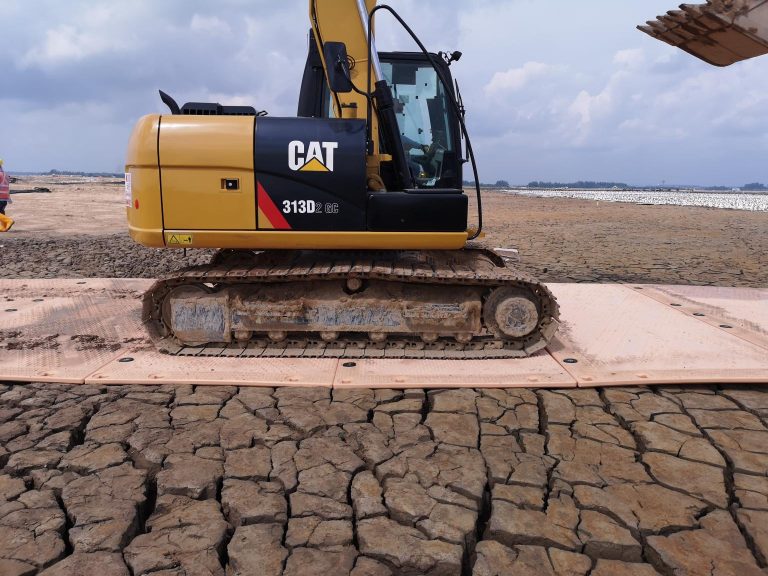
Crushed rock has been the default answer to soft ground for decades. Tip a few loads of road base, run a roller over it and you have an access road. But on wet clay, turf, landscaped areas and environmentally sensitive sites, rock is often slow to install, expensive to remove and hard on the ground underneath. This guide compares the main temporary construction access road materials used on Australian worksites, and shows how to choose the right one for your ground conditions, loads, timeframe and surface protection needs.
Why crushed rock is the default, and where it falls short
Crushed rock and road base are cheap per tonne, widely available and familiar to every crew. Once compacted, a well-built rock pad carries very heavy loads, which is why it remains the go-to for long-term haul roads and permanent driveway bases.
For temporary site access, the downsides add up quickly:
- It is slow to build. Rock has to be ordered, delivered, spread and compacted, and on very soft ground it can take several layers before it stops sinking.
- It is hard to remove. At the end of the job the rock has to be dug out, loaded and carted away, and the ground underneath reinstated.
- It contaminates the subgrade. Fines and stone push into topsoil, turf and garden beds, which is a problem on landscaped, residential and sensitive sites.
- It keeps costing. Rock compacts and pumps into wet ground over time, so it needs topping up.
- It is single use. You pay for the material, the haulage in and the haulage out on every job.
That is why many contractors are looking at crushed rock alternatives that can be laid quickly, protect the ground and be reused.
What to consider when choosing temporary access
- Ground conditions: firm and dry, soft and wet, turf and landscaping, or environmentally sensitive.
- Load demands: foot traffic and barrows, light plant, or cranes, excavators and loaded trucks.
- Deployment speed: how quickly access is needed, and whether it has to move as the job progresses.
- Surface protection: whether the ground must be returned in the same condition, such as lawns, sports fields, paving or native vegetation.
- Duration and reuse: a one-week job suits a different solution to a two-year project.
Crushed rock alternatives compared
Light-duty plastic ground mats
Lightweight LDPE mats such as Ground Mats Lite, Track Mats Lite and Tradie Mats Lite are ideal for pedestrians, wheelbarrows, ride-on mowers and small machinery. One person can carry and place them, they flex over uneven ground and they protect lawns and paving from ruts. They are a fast, clean option for residential, landscaping and trade work where rock would damage the finished surface.
Heavy-duty (HD) plastic ground mats
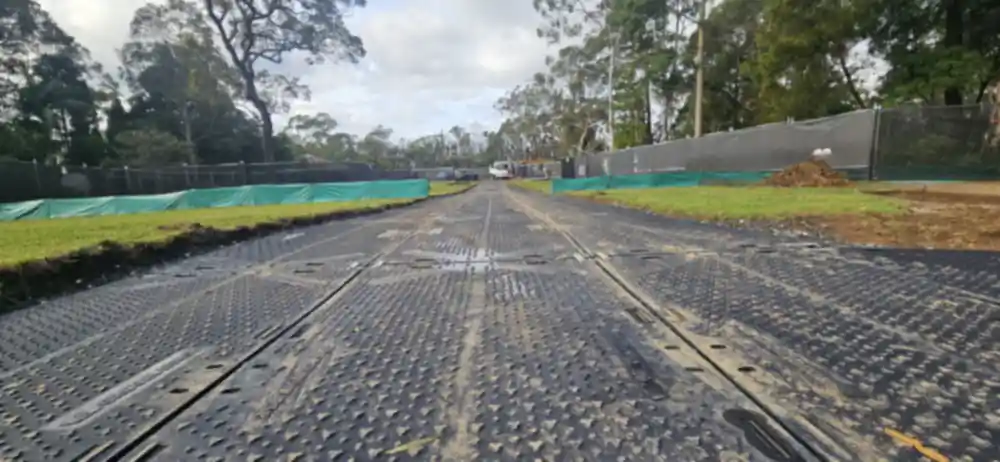
Rigid HDPE mats such as Ground Mats HD (2400 × 1200 mm) and Track Mats HD (2400 × 900 mm) suit mini excavators, skid steers, utes and EWPs. Mats are joined with plastic or HD steel connectors to form a continuous temporary road, then lifted, cleaned and reused on the next job. For many civil and building sites, HD mats replace a temporary rock track entirely.
Heavy composite mats for cranes and heavy plant
Where loads are measured in tens or hundreds of tonnes, heavy composite mats take over. Heavy Armour, Tough Armour and Extreme Armour are built for cranes, large excavators, piling rigs and haul roads. Extreme Armour 4 × 2 m mats are rated to 415 tonnes and lock together to form a stable working platform over soft, wet or sensitive ground, with no rock to dig out afterwards.
Timber and bamboo mats
Timber bog mats have long been used for heavy plant on boggy ground. They are strong but heavy, absorb water and break down over time. Eco Mat uses a bamboo composite that retains less than 10% water, so it stays lighter and resists warping while offering a renewable alternative to solid timber.
Ground stabilisation grids
Interlocking grids such as Diamond Grid, HexGrid, Stable Grid and TerraGrid are laid on a prepared base and filled with gravel, soil or grass. The cells lock the fill in place, so you get a free-draining, rut-resistant surface using far less material than a deep rock pad. Grids suit semi-permanent access tracks, overflow parking, compounds and laydown areas. Diamond Grid, for example, is load rated to 300 tonnes per m² unfilled.
Geofabric: the layer that makes everything work better
Non-woven geofabric is not a replacement on its own, but it improves almost every option. Laid under rock it separates the stone from the subgrade so less is lost into the mud. Laid under mats it stops mud pumping up through the joins and keeps the trackway firm.
Controlling mud at the site exit
Whatever you use inside the site, mud on public roads is a compliance issue. Many NSW council guidelines for stabilised site access call for a 200 mm pad of aggregate larger than 40 mm over needle-punched geotextile at the entry, and suggest shaker grids on larger sites. A Rubberform Trackout Control Mat or Rumble Grids at the exit shake mud from tyres before vehicles reach the road, and can be lifted and moved to the next site.
Comparison at a glance
| Option | Best for | Load capacity | Deployment speed | Surface protection | Reusable |
|---|---|---|---|---|---|
| Crushed rock / road base | Long-term access, permanent driveway base | Very high once compacted | Slow: deliver, spread, compact | Low: buries and contaminates the subgrade | No |
| Light-duty plastic mats (LDPE) | Foot traffic, barrows, small plant on lawns and paving | Light | Fast: one person can carry | High | Yes |
| HD plastic mats (HDPE) | Mini excavators, skid steers, utes, EWPs | Medium | Fast | High | Yes |
| Heavy composite mats | Cranes, excavators, haul roads | Very high (Extreme Armour rated to 415 t) | Moderate: needs plant to place | High | Yes |
| Timber or bamboo mats | Heavy plant on boggy ground | High | Moderate | Medium | Limited |
| Stabilisation grids | Semi-permanent car parks, tracks, driveways | High when filled | Moderate: lay and fill | Medium–high | Can be lifted |
| Geofabric | Under rock or mats on soft ground | Adds stability | Fast | Separates fill from soil | Sometimes |
How to choose by ground condition
- Soft, wet clay or boggy ground: HD plastic mats for light to medium plant, heavy composite mats for cranes and large excavators, with geofabric underneath.
- Turf, lawns and landscaped areas: light-duty or HD plastic mats. They spread the load and leave nothing behind when lifted.
- Environmentally sensitive sites: mats over geofabric to avoid importing fill, plus trackout control at the exit.
- Long-term compounds, car parks and tracks: stabilisation grids filled with gravel or grass, or a properly engineered rock pavement.
- Existing paving, kerbs and driveways: mats to protect the surface, with kerb ramps to bridge level changes.
Thinking about total cost, not cost per tonne
Rock looks cheap on a quote because it is priced per tonne. The true cost includes delivery, spreading and compaction, topping up as it sinks, excavation and disposal at the end of the job, and reinstating the ground. Mats and grids cost more upfront, but they go down faster, come up cleaner and can be reused across many projects, which usually makes them better value for contractors who regularly need temporary access.
When crushed rock is still the right call
Rock is still a good choice for long-term haul roads that will carry heavy traffic for many months, for sites where the access will become a permanent driveway or pavement, and where your conditions of consent specifically require a rock stabilised entry. Many contractors combine both: a compliant rock pad at the gate, and reusable mats or grids for internal access and work platforms.
Frequently asked questions
What is the best alternative to crushed rock for temporary access?
For most short-term jobs, reusable ground protection mats are the closest like-for-like replacement. HD plastic mats suit light and medium plant, while heavy composite mats such as Extreme Armour handle cranes and heavy excavators.
Are ground mats cheaper than crushed rock?
It depends on the job. Rock is a consumable: you pay to deliver, spread, compact and later remove it, then reinstate the ground. Mats cost more upfront but can be lifted and reused job after job, or hired for a single project.
Do I still need geofabric with ground mats?
On soft or wet ground, geofabric under the mats helps stop mud pumping up through the joins and keeps the trackway firmer. On firm, dry ground it is usually not needed.
Can mats replace a council-required stabilised site access?
Not always. Many councils specify a crushed rock pad at the site entry to control sediment. Check your conditions of consent, then use mats or grids for the rest of the internal access and a trackout mat or rumble grid at the exit.
How do I protect turf or landscaped areas during works?
Use ground protection mats rather than rock. They spread the load, leave no fill behind and can be lifted at the end of the job, so lawns usually recover quickly.
Need help choosing?
Ground Nurse stocks ground protection mats, stabilisation grids and geofabric and trackout control in Sydney, Melbourne and Brisbane, with delivery Australia-wide. Call 1300 229 300 or contact our team and we will help you match the right access solution to your ground conditions and loads.