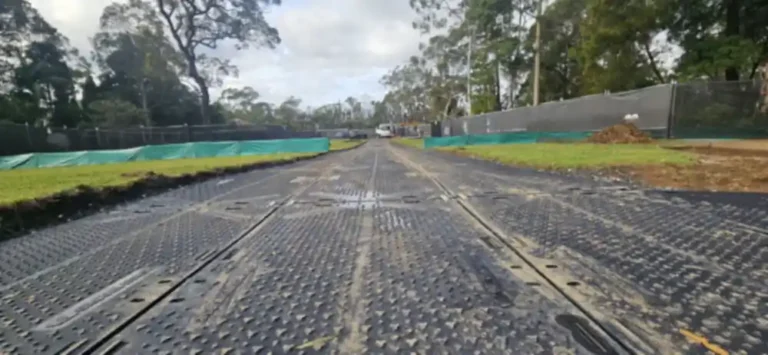
Piling rigs are some of the heaviest and tallest machines on a construction site. They carry high loads on narrow tracks, with a high centre of gravity, and they often need to work on the softest, wettest or most variable ground on the job. That is why every piling operation depends on a properly designed working platform. This article explains what working platforms for piling rigs are, why they matter on Australian sites, and how engineered ground protection mats such as Extreme Armour and Heavy Armour can improve stability, access and safety.
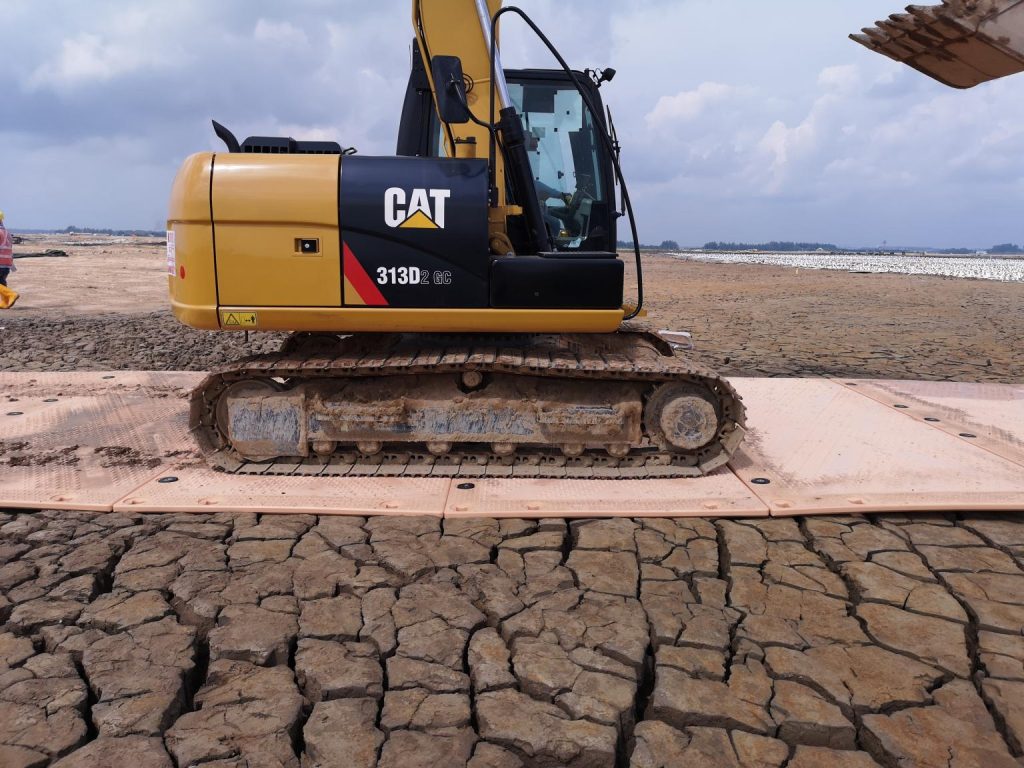
What is a temporary working platform?
A temporary working platform is a prepared surface that a piling rig, crane or other tracked plant stands on while it works. Its job is to spread the machine’s track and outrigger pressures into the ground so the rig stays level and stable, even when it is lifting, drilling or travelling with a mast raised.
Traditionally, platforms are built from imported granular fill such as crushed rock, often over a geotextile or geogrid as a form of ground improvement, then compacted to a designed thickness. When piling is finished the material is usually dug out and removed.
Why working platforms matter
Piling rig overturning incidents are among the most serious events on a construction site. They are rarely caused by the rig itself. More often, the ground or platform beneath one track gives way, the rig tilts and the load shifts beyond its stability limits. Modern rigs are heavier and taller than older machines, which raises the stakes.
In Australia, the piling industry promotes the UK guide Working Platforms for Tracked Plant as good practice, and geotechnical engineers are typically responsible for designing and specifying platforms. The design relies on the rig’s track pressures and loading cases, and on the strength of the upper soil profile, which is often the least investigated part of a site.
The challenge of soft and variable ground
Soft ground access is a common problem on Australian projects: reactive clays that turn to mud after rain, uncontrolled fill on urban infill sites, low-lying coastal and estuarine soils, and sites that change from firm to soft within a few metres. Variable ground conditions make platform design harder, because a platform that suits one area of the site may be inadequate a short distance away.
- Soft spots can cause one track to sink, tilting the rig.
- Wet weather can weaken a granular platform that performed well when dry.
- Platforms get damaged by repeated tracking, spoil and arisings, and need regular inspection and repair.
- Importing, compacting and later removing fill adds time, truck movements and cost.
How engineered ground mats help
Heavy-duty composite mats give site teams another option for piling rig support. Laid as a continuous, interlocked surface, they spread loads over a large area, provide a level and consistent footing, and protect the ground or platform underneath. Depending on the site and the engineer’s design, mats can be used to form the working platform, to strengthen and protect a granular platform, or to build access routes and haul roads to and around the piling area.
Extreme Armour mats
Extreme Armour mats are built for the heaviest loads on site. Each mat is 4 × 2 m and 94 mm thick, made from high-density polyethylene, and rated to 415 tonnes. They lock together with the Fast Four connector pin system to form a continuous surface, have dual traction faces for tracks and tyres, and a foam-filled core that stops liquid getting in. Integrated lifting points mean they can be handled with hooks, slings, eye bolts or forklifts. Ramps, corner pieces and mud caps complete the system.
For piling, Extreme Armour suits rig platforms, crane pads for support cranes and heavy haul roads where loads are highest and ground is poorest.

Heavy Armour mats
Heavy Armour mats are a lighter, more portable option. Each mat is 3 × 2 m and 38 mm thick, made from a tough composite that resists chemicals, oil and UV, and supports vehicles and equipment up to 100 tonnes depending on ground conditions. They join with the Heavy Armour Connector Kit and can be laid without ground preparation.
On piling projects, Heavy Armour works well for access tracks, laydown areas, and support plant such as excavators, telehandlers, concrete trucks and smaller rigs, keeping the whole site moving while the main rig works on its platform.
Benefits of matted working platforms
- Stability: a level, interlocked surface spreads rig loads and reduces the risk of one track sinking.
- Speed: mats are placed and connected in hours, not days, and can be moved as the rig progresses.
- Less imported fill: fewer truck movements, less compaction and less material to remove at the end.
- Ground protection: the subgrade, existing pavements and sensitive areas are protected rather than buried.
- Consistency in wet weather: mats keep their performance when the ground gets wet.
- Reuse: mats are lifted, cleaned and reused on the next job.
Planning a working platform with mats
- Start with a geotechnical assessment of the upper soil profile and the rig’s track pressures.
- Have the platform designed or checked by a qualified engineer, including whether mats form the platform or sit on top of a granular layer.
- Choose the mat to suit the load: Extreme Armour for the heaviest rigs and cranes, Heavy Armour for access and support plant.
- Use geofabric under mats on very soft ground to stop fines pumping up.
- Inspect the platform daily, particularly after rain, and keep a record.
Ground mats do not remove the need for engineering. They are a tool that helps a well-designed platform perform better and makes soft ground access safer and faster.
Frequently asked questions
What is a working platform for a piling rig?
It is a prepared, load-bearing surface that a piling rig stands and tracks on while it works. It spreads the rig’s track and outrigger pressures into the ground so the rig stays level and stable.
Can ground mats replace a granular working platform?
Sometimes, but not automatically. On some sites engineered mats can form the platform or part of it; on others they work best on top of a granular platform or as access routes. The platform should always be designed or checked by a qualified geotechnical engineer for the specific rig and ground.
What is the difference between Extreme Armour and Heavy Armour mats?
Extreme Armour mats are 4 × 2 m, 94 mm thick and rated to 415 tonnes, built for the heaviest rigs, cranes and haul roads. Heavy Armour mats are 3 × 2 m and 38 mm thick, and support vehicles and equipment up to 100 tonnes depending on ground conditions, making them a lighter option for access routes and support plant.
Do I still need a geotechnical assessment if I use mats?
Yes. Mats spread load very effectively, but the ground underneath still has to carry it. A geotechnical engineer should confirm the bearing capacity of the upper soil profile and the platform build-up for your rig.
How quickly can a matted platform be installed?
Much faster than importing and compacting fill. Mats are placed with an excavator or forklift using their lifting points, connected together, and can be lifted and reused as the rig moves or when the job finishes.
Talk to Ground Nurse
Ground Nurse supplies Extreme Armour and Heavy Armour mats from warehouses in Sydney, Melbourne and Brisbane, with delivery Australia-wide. Call 1300 229 300 or contact our team to discuss mats for your next piling project.